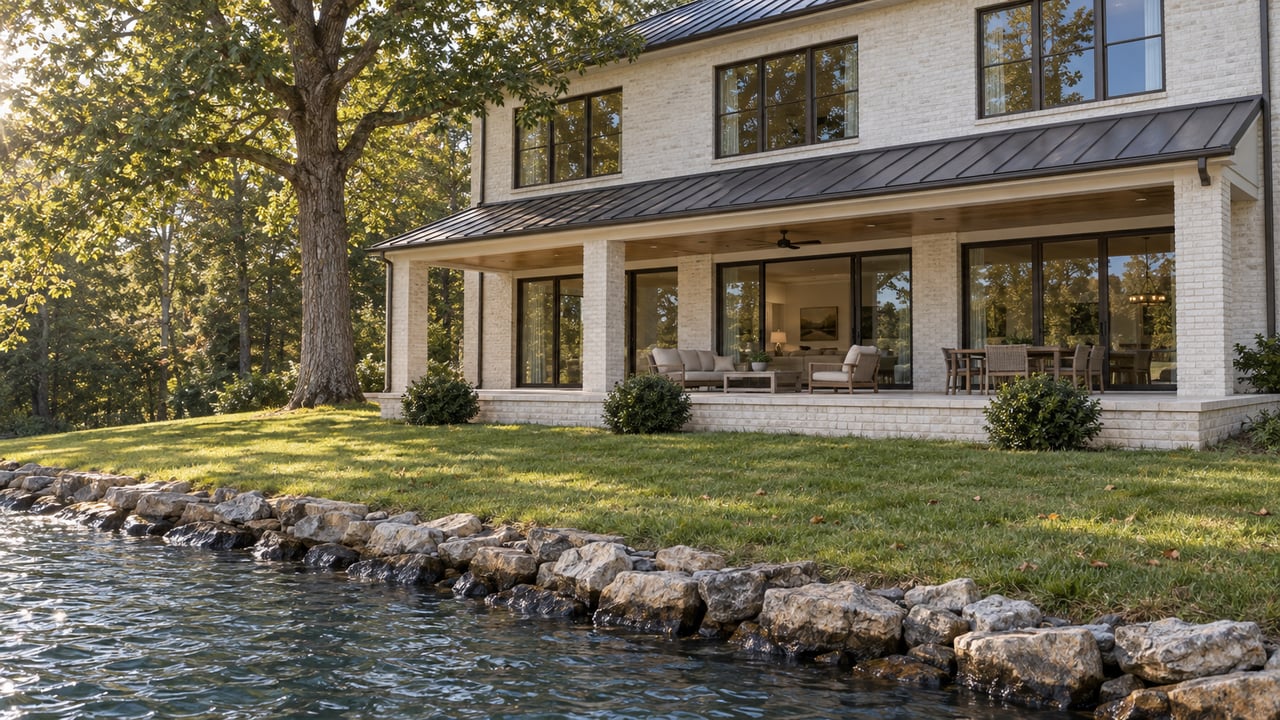
On Lake Norman, the dock you see in the listing photos is not, legally speaking, part of the house. It sits on land Duke Energy controls under the Catawba-Wateree Shoreline Management Program, and the permit that authorizes it doesn't move with the deed the way a kitchen or a roof does. A buyer can close on a home with a covered boat lift photographed from every angle and still end up owning a structure the county and Duke Energy don't fully recognize as compliant, because the parcel's shoreline classification, not the seller's paperwork, decides what's actually allowed to sit in the water.
That distinction matters more this year than most, and not just because of the permit rules themselves. It's because the number most buyers use to gauge whether a Lake Norman waterfront home is fairly priced, the median, is quietly blending several different markets into one figure, and the dock is where that blending becomes a real financial risk rather than an abstract statistic.
The Permit Is a Separate Transaction Running Parallel to Yours
Every dock, pier, boat lift, or seawall on Lake Norman needs Duke Energy's approval before it's legal, regardless of what the county has permitted for the house itself. That approval is tied to the parcel's shoreline classification, and classifications aren't uniform across the lake. One cove can allow a covered boathouse. The cove next to it might restrict or prohibit one entirely, which means a structure that's been sitting there for years could be grandfathered in a way that doesn't survive a modification request or a straightforward permit transfer at sale.
The practical version of this: a buyer falls for a house because of the dock, the offer gets accepted, and only during due diligence does anyone ask whether the permit is current, whether it's in the seller's name, and whether it actually authorizes what's built. By then, the buyer has already anchored their offer price to a feature they haven't verified they'll be able to keep using.
The timeline adds pressure here too. From application to a finished, approved dock typically runs three to six months, longer if state or federal agencies get involved. A buyer who wants a dock ready by summer and is starting the permit process at closing is already behind.
There's a newer wrinkle as of this year. Effective July 1, 2026, Duke Energy stopped reviewing new private dock applications for parcels where no home has been built yet. That single rule change reshapes the calculus for anyone eyeing vacant Lake Norman land with the idea of building a dock before or alongside construction. The sequencing now runs house first, dock application second, on every lake Duke manages, not just Lake Norman.
Before writing an offer on any waterfront parcel, it's worth confirming:
- The parcel's current shoreline classification directly with Duke Energy, not from the listing description
- Whether the existing dock permit is active, in the seller's name, and set up to transfer
- Whether a covered structure on the property is actually authorized under current rules or grandfathered in a way that limits future changes
- Water depth at the dock during low-water conditions, not just on the day of the showing
One Median, Several Different Lakes
The headline number that circulates for Lake Norman waterfront, a median in the $2.3 million range as of Q1 2026, is the figure most buyers start with. It's not wrong. It's also not the number that describes what's actually closing month to month, because it blends every town on the lake and every kind of waterfront, from main-channel estates to modest cove lots, into a single line.
Look at the most recent verified month of closings instead. In May 2026, direct-frontage waterfront sales across the lake's four counties posted a median of roughly $1.65 million against an average closer to $2.5 million. That gap between median and average isn't noise. It's a small number of trophy sales, an Island Drive property in Huntersville that closed at $12.5 million and a Jetton Road home that sold for $5.8 million, 15% over asking, pulling the average well above what a typical buyer will actually pay. Anyone anchoring their budget to the average is comparing themselves to outliers, not to the market they're shopping in.
The town-level breakdown for that same month tells a more useful story:
| Town | May 2026 waterfront activity | Median sale |
|---|---|---|
| Mooresville | 11 of 22 verified closings, half the lake's volume | $1.465 million |
| Cornelius | 2 closings | Averaged $3.56 million |
| Denver | 4 closings | $1.86 million |
| Troutman / Sherrills Ford | Realistic direct-frontage entry point | Roughly $950,000 to $990,000 |
| Denver (Westcape) | Waterfront townhome entry | Starting near $560,000 |
Nearly half of the lake's waterfront closings that month came in under $1.5 million, which means the "waterfront is a luxury-only market" assumption doesn't hold up town by town. Mooresville is doing the heaviest lifting on volume. Cornelius is thin on inventory but expensive when something does trade. Denver and the Troutman/Sherrills Ford corridor remain the places where a buyer can get into direct frontage without competing at the top of the market.
The takeaway isn't that the $2.3 million figure is fake. It's that a single lake-wide median was never built to answer the question most buyers are actually asking, which is what a waterfront home costs in the specific town they're comparing, this month, not the quarter before.
The Drought Isn't Over, It's Improving, and That Distinction Matters at the Dock
Lake Norman spent the spring and early summer of 2026 in a genuine drought. Duke Energy issued a Stage 1 drought advisory for the Catawba-Wateree basin in April, and by mid-May the lake had dropped to 94 feet, about three feet lower than the five-year May average, low enough that park rangers closed four of the six boat ramps at Blythe Landing. By mid-June the lake was still running roughly four feet below full pond, and TowBoatUS crews reported a steady stream of calls from boaters stranded on newly exposed shoals.
The most recent readings show the trend turning, with the lake sitting around four feet below full pool and ticking upward week over week rather than continuing to fall. That's good news, but it doesn't erase the year's core lesson for anyone shopping waterfront: a cove that looked fine in a spring listing photo can be a different property entirely by August, and a showing on a good week tells you nothing about how that same dock performs during the next dry stretch. Duke Energy's own guidance is to evaluate dock usability at lower seasonal targets, not at peak levels, and 2026 is the year that guidance stopped being theoretical for a lot of Lake Norman shoreline.
For a buyer comparing two similarly priced coves, the deeper one, or the one closer to the main channel, carries less of this risk than a shallow cove that depends on a wetter year to stay usable.
What to Check Before the Number on the Portal Becomes Your Offer
The waterfront median tells you what the lake cost last month. It doesn't tell you whether the dock in front of the specific house you're touring is legally yours to keep using, whether that house's town puts it closer to Mooresville's $1.465 million reality or Cornelius's thin, expensive inventory, or whether the cove it sits on held up through a drought year that just started to ease. Those three answers live in the permit file, the town-level closings, and the current lake reading, not in the headline number.
A buyer who checks all three before writing an offer is negotiating from a stronger position than one who's simply comparing sticker prices.
FAQ
Does a dock permit automatically transfer to a new owner when a Lake Norman waterfront home sells? Not automatically. The permit sits with Duke Energy's shoreline management system, and buyers should confirm before closing that it's active, correctly assigned, and covers what's actually built on the property.
Can I still get a dock permit if I buy vacant waterfront land on Lake Norman? As of July 1, 2026, Duke Energy no longer reviews new dock applications for parcels without a home already built on them, so the sequencing now requires construction first.
Is Lake Norman waterfront currently in a drought? The 2026 drought that pushed the lake to 94 feet in May and closed boat ramps at Blythe Landing has been easing, with recent readings showing the lake several feet below full pool but trending upward.
If you're comparing Lake Norman waterfront listings this fall and want someone to run the permit history, the town-level numbers, and the current lake conditions before you write an offer, Morey Realty Group is a call away.
